
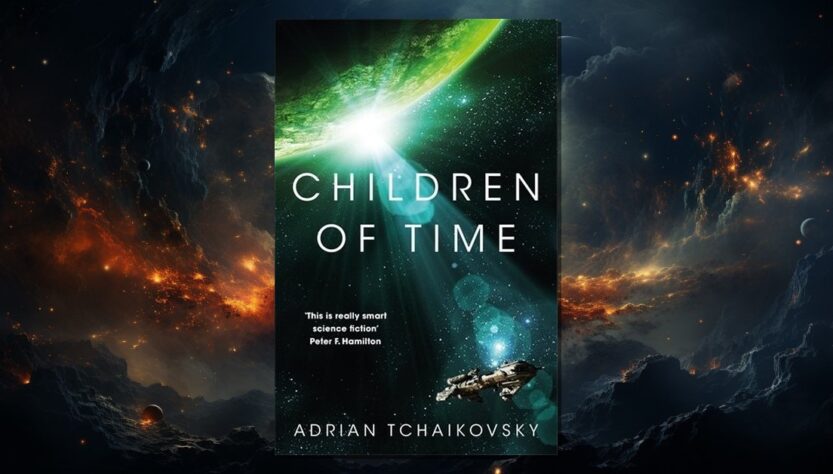
Adrian Tchaikovsky wrote a book that made me genuinely root for spiders. If you knew me, you’d understand what an achievement that is.
“Children of Time” has an irresistible premise. Humanity’s last great terraforming project goes sideways. A nanovirus designed to accelerate evolution on a distant world misses its intended targets and instead lands on something with eight legs. What follows is one of the most ambitious and inventive sci-fi novels I’ve read in years. This is a dual-timeline epic that charts the rise of an entire alien civilisation alongside humanity’s desperate search for a new home.
The spider chapters are where this book absolutely sings. Tchaikovsky doesn’t just hand-wave the evolution; he grounds it in real biology, showing how spider societies might develop communication, engineering, even religion, all filtered through genuinely alien physiology. Portia, the recurring name passed down through generations, becomes as compelling a protagonist as any human in the genre. You’ll catch yourself thinking about spider architecture on the train home. It’s that kind of book.
Why Should I Read This Book?
The worldbuilding is extraordinary. Watching intelligence emerge from scratch, grappling with the same fundamental challenges every civilisation faces but through a completely alien lens, is endlessly fascinating. The big ideas here (consciousness, communication, inheritance, what it actually means to build a culture) are the kind that rattle around your head for weeks.
If you loved the xenobiology in “Semiosis” by Sue Burke, or the deep-time civilisation building in Vernor Vinge’s “A Fire Upon the Deep,” this is in that tradition but arguably more ambitious than either. It won the Arthur C. Clarke Award for good reason.
And honestly, if you’ve ever wanted a book that makes you rethink what intelligence even means, this is it.
Why Shouldn’t I Read This Book?
Let’s be honest about the human chapters. They’re fine. They do their job. But they’re also the bits where you find yourself itching to get back to the spiders. The human characters are painted in broader strokes. Holsten Mason is serviceable as a viewpoint but he’s no Portia. The contrast is clearly deliberate, and it works thematically (that’s rather the point), but there are stretches in the middle where the pacing dips and you feel the page count.
The generational time jumps also mean you’re constantly meeting new iterations of characters rather than spending extended time with individuals. If you prefer deep, sustained character work with one protagonist across a whole novel (something like “The Left Hand of Darkness”), that’s not what’s on offer here.
And if spiders genuinely make your skin crawl? Well, this book won’t help with that. At all. You’ve been warned.
“Children of Time” is a remarkable piece of speculative fiction. The spider civilisation thread is among the best things I’ve read in the genre, full stop. The human side keeps things moving without quite reaching the same heights. A very strong four stars. It’s the kind of book you’ll be thinking about long after the last page, and one that makes you immediately want to pick up the sequel.
⭐ Rating: 4/5
🎧 Get this as an audiobook on Audible
Discover more from Unfolded Universe: Sci-Fi Book Reviews
Subscribe to get the latest posts sent to your email.